
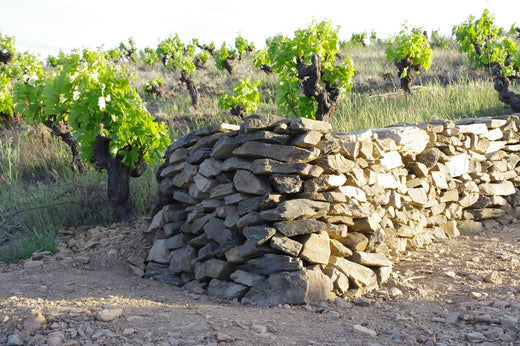
Languedoc-Roussillon Deep Cultivation Faugères
Faugères is an Appellation d'Origine Contrôlée (AOC) in the Languedoc-Roussillon region of France, named after the town of Faugères, located 30 km north of Béziers at the foot of the Massif Central in the Hérault department. It is a subdivision of the Coteaux du Languedoc AOC.
The history of Faugères
Faugères' wine-growing prosperity began around the time of the French Revolution, at the beginning of the 19th century, when the local wine was used primarily to produce eaux-de-vie, using a Charente distillation method that had previously been unknown in Languedoc. This method was called "Foufine" and the eaux-de-vie were named "Fine Faugères".
In 1982, Faugères' red and rosé wines were elevated from AOVDQS to AOC status. Eau-de-vie production, which had been suspended in the 1980s, resumed in 2000, and in 2005 the white wines were also elevated to AOC status.
The Faugères terroir
The appellation covers an area of 1,800 hectares, with primarily virgin schist soils. Most of the vineyards face south and are located on steep slopes. Some hills in the north of the appellation reach an altitude of more than 500 metres, higher than the surrounding areas. The Director of Agriculture, in collaboration with SAFER (the French regional association for the development of land and rural facilities), is experimenting with situating vineyards along contour lines to reduce the effects of erosion.
The soil of Faugères is mainly composed of schist, a metamorphic rock that resulted from excessive pressure on clayey sediments during the Palaeozoic era, which led to the formation of the Massif Central to the north. Schist is characterized by its ability to retain large amounts of water (up to one-third of its volume) and its ability to store heat, absorbing it during the day and releasing it at night.
Faugères winegrowers often say that "grapes ripen overnight." The commune of Cabrerols is home to a geological rarity: a meteorite crater, formed 10,000 years ago by the impact of a borite meteorite, some 20 meters wide. Syrah vines have been planted in this crater (in two stages, in 1984 and 1992), and Domaine du Météor produces wine there.
The terroir has a Mediterranean climate with mountain influences, characterized by mild winters, hot, dry summers and little rainfall, mainly in winter. Two types of wind are present: the Tramontane, a dry, cold wind that blows away the clouds, and the Marine, a humid wind that attracts the clouds.
Faugères wine
The main grape varieties are Carignan, Cinsault, Grenache, Mourvedre, and Syrah for red grapes, and Roussanne, Grenache Blanc, Marsanne, and Vermentino for white grapes. 80% of the production is for red wine.
The vines are planted against the slope to maximize exposure to the southern sun. After the storms of the 1960s, Faugères winegrowers replanted many of their vines along the contours of the landscape. They are now adapted to the natural slope of the schist hills, making them much less susceptible to erosion from heavy autumn rains than other vineyards in the Languedoc. Similar projects are being considered in Saint-Chinian and the Coteaux du Languedoc region.
There are two cooperatives and 44 independent producers, including the famous Léon Barral, known for its elegant wines.
Overall, Faugères wines are characterized by their mellowness, ripe fruit and soft tannins.
Handling producers
Domaine Montrose is the result of the Coste family business, which for over 300 years has been pursuing winemaking know-how and working lovingly to ensure its continued transmission to future generations.
Brigitte Chevalier came to Faugères to create wines in her own unique style, and her 11-hectare organic domaine quickly established itself as a leader among the most renowned producers in the South of France.

Written by 秋元賢介
Private Sales Manager at Cépages and a JSA-certified sommelier, with more than 20 years in the trade, largely at major and independent wine retailers. Writes with the aim of bridging passionate producers and drinkers in Japan, carrying that enthusiasm through to the page.
%20in%20the%20Languedoc-Roussillon%20region%20of%20France,%20named%20after%20the%20town%20of%20Faug%C3%A8res,%20located%2030%20km%20north%20of%20B%C3%A9ziers%20at%20the%20foot%20of%20the%20Massif%20Central...)
Leave a comment
This site is protected by hCaptcha and the hCaptcha Privacy Policy and Terms of Service apply.