
Article: Before You Open a Thirty-Year-Old Burgundy: Drinking Windows, Opening and Temperature
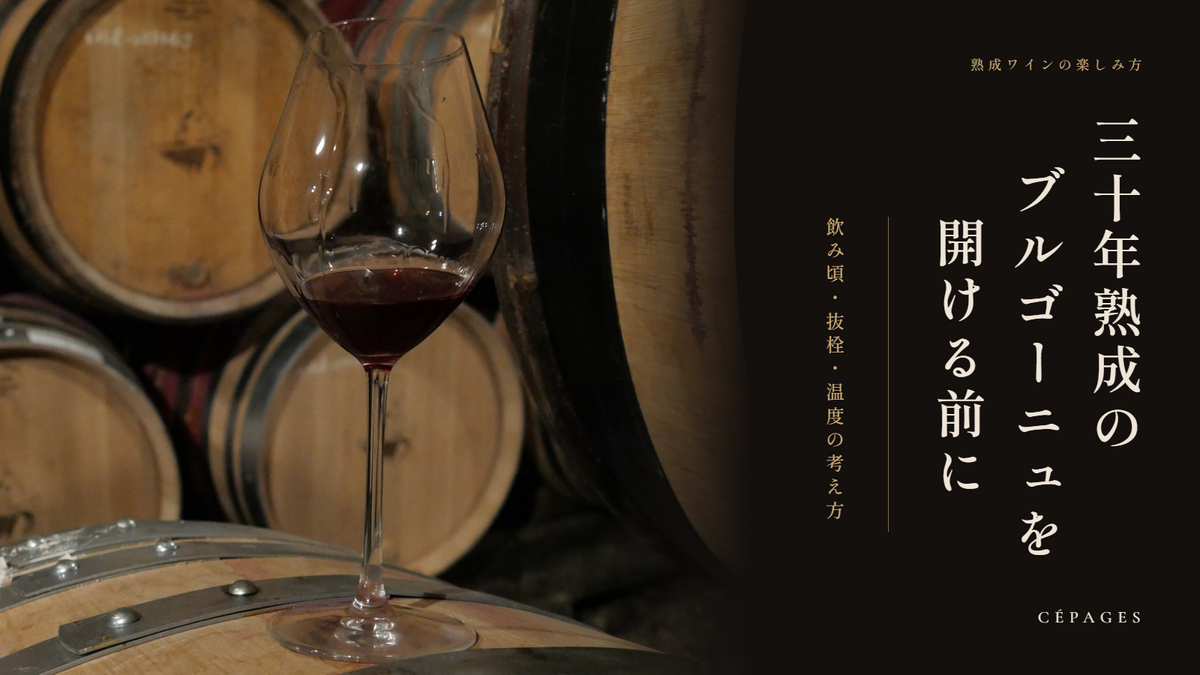
Before You Open a Thirty-Year-Old Burgundy: Drinking Windows, Opening and Temperature
On December 10, we will open a 33-year-old Grands-Échezeaux: the 1993 from Dominique Laurent.
On the night, opening and service will be in the hands of the venue's sommelier. Even so, with an irreplaceable bottle in front of me, I cannot help thinking, as the host, about how it should be prepared and how I would like it served. An old Burgundy can become a different wine depending on how it is opened.
In more than twenty years on the floor of wine shops, the two questions I was asked most often about mature wine were "When should I open it?" and "Should I decant it?" This article is my answer to both. To give the conclusion first: with old wine, resting the bottle before you open it matters more than waiting after you open it.
A drinking window is a range, not a point
A wine's drinking window is not a peak that arrives in one particular year. It is more like a gentle plateau that lasts anywhere from a few years to well over a decade.
Where on that plateau you like to be is a matter of taste. Some people prefer the early part, while the fruit is still clear. Others wait for the later part, when forest floor, black tea and leather come forward. Both are right.
One more thing: past thirty years, the difference between bottles becomes greater than the difference between vintages. The same wine from the same year will show differently depending on where and how it has spent its life. That is why, when I choose a mature wine, I check its provenance before I look at the year.
The 1993 red Burgundies were said to be firm in acidity and tannin when young. How does a wine from a year like that unwind over thirty years? That is what I am looking forward to on December 10.
Before opening: stand the bottle and let it rest
Preparing an old Burgundy begins days before the cork is pulled. The purpose is to let the sediment settle.
Pinot Noir sediment is fine and light. Unlike the coarse sediment of an old Bordeaux, which drops quickly, it takes days to settle once it has been stirred up. Pour the wine while the sediment is still in suspension and it will be cloudy, with bitterness and a gritty texture.
My rules of thumb are these:
- After shipping or carrying a bottle, leave it undisturbed for one to two weeks
- Once you have chosen the day, stand it upright at least several days ahead, and a week or more if you can
- On the day, carry it upright and gently. Do not lay it down and do not shake it
The Grands-Échezeaux for December 10 will be standing upright from two weeks beforehand.
When to pull the cork, and whether to decant
In my view, a Burgundy older than thirty years is better not decanted.
There are two reasons. First, the aromas that come with age are delicate, and a sudden, large exposure to air can thin them out within a matter of tens of minutes. Second, there is little to gain from transferring the wine. If the bottle has been stood and rested properly, the sediment stays at the bottom. Pour gently and leave the last small amount in the bottle, and that is enough.
The same thinking applies to timing. On December 10, I intend to have all six Burgundies opened just before they are served. I want every guest to enjoy the whole course of the wine together, from how it shows the moment it is opened to how it unfolds over time.
I know there is a school of thought that pulls the cork early and leaves the bottle for several hours. It is a reasonable approach. But the real pleasure of old wine lies in how the glass changes, minute by minute, over the thirty minutes or the hour after pouring. Precisely because seven of us will share one bottle, I want us to follow that change together from the very beginning.
Young wines are generally a different matter. Many of them show more when opened early or decanted. Even so, this time the 2019 whites and the 2018 Volnay will also be opened just before serving. How differently do young and old wines open up, and how fast? That is something else I would like us to compare.
Temperature and glassware
For an old red Burgundy, my standard is to pour at 15 to 16°C and let it rise to around 17°C in the glass.
Served at room temperature, the alcohol stands out and the wine loses definition. Too cold, and the aromas of age stay closed. If in doubt, start a little cooler. You can always let a wine warm up, but you cannot cool it down once it is poured.
A large Burgundy glass is fine. Just do not swirl it hard. An old wine gives up its aromas on its own. Pour small amounts, and follow the changes over several pours.
The same goes for Champagne. It would be a waste to drink a thirty-year-old Champagne from a flute. Pour it into a white wine glass and drink it a little warmer, at 10 to 12°C, and the aromas of age behind the bubbles come into view.
How I plan to have the wines served on December 10
On the night, seven wines will be served in the order below, from the 1996 Champagne to the 1993 Grands-Échezeaux. Opening and service will be entrusted to the venue's sommelier, so what follows is how I would like each wine to be served.
| No. | Wine | Vintage (age) | Serving approach |
|---|---|---|---|
| 1 | Duval-Leroy Femme de Champagne Grand Cru | 1996 (30 years) | In a white wine glass, not too cold |
| 2 | Domaine Vincent Dauvissat Chablis 1er Cru Séchet | 2021 (5 years) | The way into the whites: acidity and minerality, clear and precise |
| 3 | Domaine Étienne Sauzet Puligny-Montrachet 1er Cru Les Combettes | 2019 (7 years) | Opened just before serving, to follow its change in the glass |
| 4 | Domaine Albert Grivault Meursault 1er Cru Perrières | 2019 (7 years) | Side by side with Combettes: two neighbours across the village boundary |
| 5 | Domaine Marquis d'Angerville Volnay 1er Cru Taillepieds | 2018 (8 years) | The way into the reds: making the most of its youth, starting slightly cool |
| 6 | Dominique Laurent Charmes-Chambertin Grand Cru | 2013 (13 years) | To see the stage where fruit and aged aromas begin to merge |
| 7 | Dominique Laurent Grands-Échezeaux Grand Cru | 1993 (33 years) | No decanting, opened just before serving; everyone follows it as it opens |
The three reds run 2018, 2013 and 1993. They walk, in order, through the near side, the entrance and the far end of the "plateau" I described at the start.
The last two bottles are both from Dominique Laurent, twenty years apart. He was once known for a style built on a lavish use of new oak. That oak stood at the front of the wines in their youth. How far has it integrated after 13 years, and what does it become past thirty? That is what I want to savour on the night.
*The wines served may change depending on availability and the condition of the bottles.
The time before opening is part of the wine
A mature wine is not something you taste only at the moment it is opened. The two weeks it spends standing upright, and the hour spent bringing it to temperature, are a continuation of its thirty years.
If you have an old Burgundy resting in your cellar at home, the next time you plan to open one, start by deciding when you will stand it upright. That alone will change what is in your glass.
And if you would like to find out, together with us, what a 33-year-old Grands-Échezeaux has become: the table on December 10 seats only seven, and just a few seats remain.
A Thirty-Year Journey ― From Champagne to Grands-Échezeaux
- Date: Thursday, December 10, 2026, from 19:00
- Venue: est (Four Seasons Hotel Tokyo at Otemachi, 39th floor)
- Price: ¥110,000 per person (tax and service charge included)
- Seats: 7 (only a few remaining)
*Guests under the age of 20 cannot be admitted.
Written by 秋元賢介
Private Sales Manager at Cépages and a JSA-certified sommelier, with more than 20 years in the trade, largely at major and independent wine retailers. Writes with the aim of bridging passionate producers and drinkers in Japan, carrying that enthusiasm through to the page.

Leave a comment
This site is protected by hCaptcha and the hCaptcha Privacy Policy and Terms of Service apply.