
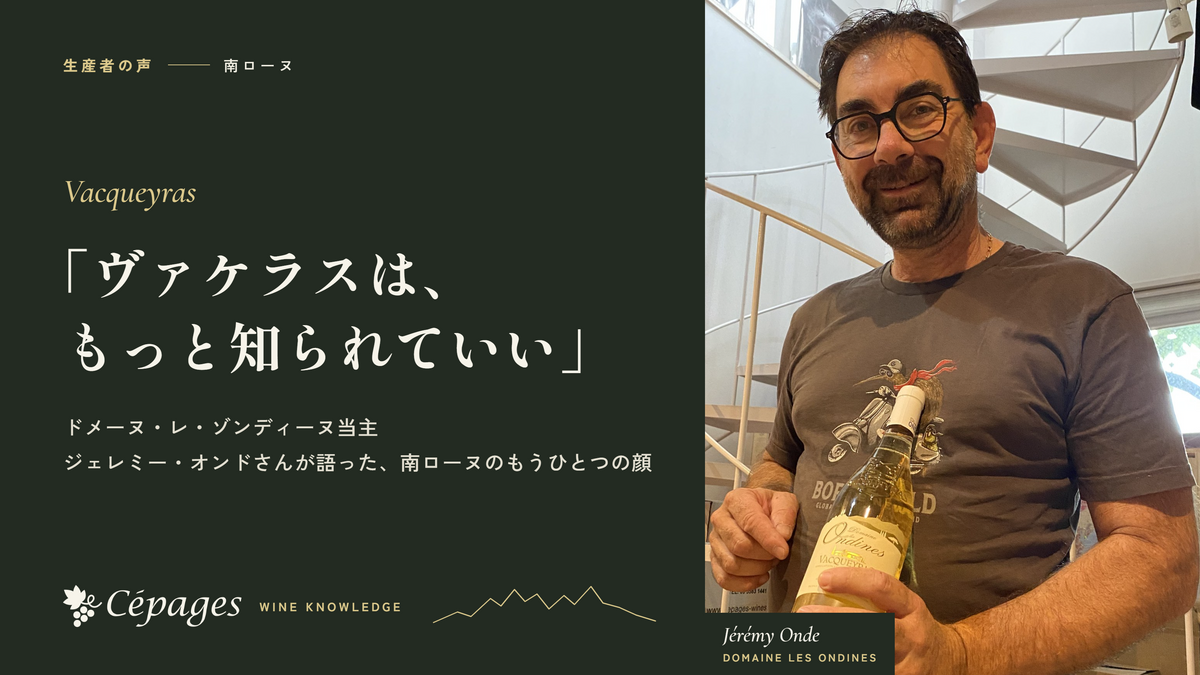
“Vacqueyras deserves to be better known” — Jérémy Onde of Domaine Les Ondines on the other face of the southern Rhône
Jérémy Onde, owner of Domaine Les Ondines in Vacqueyras in the southern Rhône, recently came to see us at the Cépages office in Akasaka.
What he kept coming back to was not his own wines but how interesting Vacqueyras is as a place. If the southern Rhône means Châteauneuf-du-Pape to you, this account of what Jérémy told us is written with you in mind.
The villages left in Châteauneuf's shadow
Say “southern Rhône” and the first name that comes up is Châteauneuf-du-Pape. The story of the popes' wine, the vineyards strewn with large rounded stones, the weight and depth in the glass: in both fame and price it stands a head above the rest of the region.
Gigondas comes next. Its reputation has risen in recent years, and it now appears on wine lists as the bottle to choose after Châteauneuf.
And beyond that? Vacqueyras, Rasteau, Cairanne, Beaumes-de-Venise. Each is an appellation in its own right, yet in Japan their individual characters are rarely discussed. Most often they are grouped together simply as “southern Rhône reds”.
That was exactly Jérémy's point. Vacqueyras is not a substitute for anything else. It has a face of its own.
What sets Vacqueyras apart
The ridge line on the label
Pick up a bottle of Les Ondines and you will notice that the top edge of the white label is cut in a jagged line. Jérémy explained that it is the skyline of the Dentelles de Montmirail. Along this saw-toothed range of rock lie the villages of Sablet, Séguret, Gigondas, Vacqueyras and Beaumes-de-Venise. Behind them rises Mont Ventoux, the highest peak in the area. “You have Mount Fuji, I have Ventoux,” he said with a smile.
The vineyards of Vacqueyras spread out at the foot of the Dentelles. At their centre is the Plateau des Garrigues, a flat but elevated, stony terrace that accounts for more than half of the appellation. The Mistral, the north wind that sweeps across it, dries the vines and keeps the grapes healthy.
Three appellations side by side
Châteauneuf-du-Pape, Gigondas, Vacqueyras. Grenache leads in all three, but the ground beneath is quite different.
| Châteauneuf-du-Pape | Gigondas | Vacqueyras | |
|---|---|---|---|
| Terrain | Gentle plateaux close to the Rhône | The slopes of the Dentelles de Montmirail, reaching around 600 m at the highest | An elevated terrace at the foot of the Dentelles (the Plateau des Garrigues) and the slopes above it |
| Soils | A mosaic of large rounded stones (galets roulés), sand, clay and limestone | Limestone and marl on the slopes, with deep soils | Small rounded stones once carried by the Ouvèze, with sandy clay; sandier on the slopes near the village |
| Character of the wines | Weighty and opulent, on a grand scale | Firm structure and power | Ripe fruit and roundness; approachable from a young age |
The stones of Châteauneuf store the heat of the day and push the grapes to full ripeness. In Gigondas, the shade of the mountain, the altitude and the deep limestone soils give firm, powerful wines.
Vacqueyras stands between the two. Its stony plateau shares the southern Rhône character of Châteauneuf, but the stones are smaller and the soils drain freely, so the wines do not become too heavy. The British wine writer Andrew Jefford, setting it beside a broad-chested Châteauneuf and a spruce Gigondas, called Vacqueyras the “Prince Charming of the south”.
Not expensive, yet it speaks clearly of its place
Jérémy makes no secret of the fact that Vacqueyras is not as expensive as Châteauneuf-du-Pape. What it offers instead is ease. You can open it without ceremony and it slips down at the table. And yet the great soils of the southern Rhône, the rounded stones, the clay and the dry wind, show clearly in the glass.
Being within reach and expressing a terroir can go together, and in his view Vacqueyras is a good example of that.
It was not always so. “When I was younger, Vacqueyras was rough. You knew your mouth was going to be full of tannin,” Jérémy recalls. Over the past twenty years or so the appellation has changed a great deal.
How Les Ondines works — farming the vineyard as one living thing
Domaine Les Ondines lies in the heart of Vacqueyras, on the Plateau des Garrigues in the village of Sarrians. The vineyards look out at the Dentelles de Montmirail with Mont Ventoux behind them, on old alluvial soils of gravel and stone, with the amount of clay varying from parcel to parcel. Because the Mistral can blow at more than 100 km/h, the rows are planted along the line of the wind.
Organic and biodynamic farming in Jérémy's generation
Jérémy's father grew grapes to sell, and strawberries too. Jérémy himself studied mathematics at university and spent two years in front of a screen at an investment bank in Paris. But the passion for wine that began when he helped with his father's harvest as a student never left him, and in the end he quit the bank. After training in Châteauneuf-du-Pape and in Australia, he built his own cellar from scratch in 2003. His first wine was a red Vacqueyras.
He has farmed organically from the start. “The opposite of my father,” as he puts it. In the France of the 1980s, growers were expected to use fertiliser and produce volume above all. Having grown up watching that era, he chose from the outset to farm without chemicals, and obtained certification in 2008. Today he goes a step further and farms biodynamically.
A cycle made by 250 sheep
What stayed with me most was the sheep. Les Ondines grazes more than 250 of them on the estate.
The sheep eat the grass in the vineyards, their manure feeds the soil, and the enriched soil feeds the vines. No herbicides or chemical fertilisers are brought in from outside; everything circulates within the vineyard, a fully closed-loop way of farming. It is the biodynamic ideal of treating the farm as a single living organism, put directly into practice.
On a dry plateau, whether the soil can hold water decides the quality of the grapes. Building a living soil is not only a matter of principle. It is also the practical answer to making good wine here year after year.
Délestage, learned in Australia
In the cellar, Jérémy sets great store by délestage, a technique he learned during his time in Australia. The wine is drawn off from the tank during fermentation and then poured back over the cap of skins once it has sunk. It is done by gravity, without relying on pumps.
Because the skins are not handled roughly as their components are extracted, the tannins lose their hard edges. That is why the reds of Les Ondines are round and supple, quite unlike the “rough” Vacqueyras of the past.
Thirty per cent white — betting on the white grapes of the southern Rhône
There is one more thing you cannot leave out when talking about Les Ondines: white wine.
Vacqueyras is overwhelmingly a red appellation, and white accounts for only around 5% of the whole. For most growers, white is something they make a little of. At Les Ondines, it makes up about 30%.
Asked why, Jérémy's answer was that he likes white wine. But there is more to it than that. He sees great potential in the white grapes of the southern Rhône.
He already had a few white vines, and planted more in 2006 and 2007. At the time there was hardly any white wine in Vacqueyras.
The turning point came when he was able to live from wine alone and gave up the strawberry growing that had continued since his father's day. The former strawberry fields lay within the Vacqueyras appellation, and there he planted six hectares of white grapes. Normally the area that can be newly planted is strictly limited. Reckoning that at that rate the planting would take fifteen years, he wrote directly to the INAO, the body that oversees French appellations, in Paris, and was granted the planting rights.
He planted mainly Clairette, along with Grenache Blanc, Bourboulenc and Roussanne. He puts particular emphasis on Clairette and Bourboulenc, varieties that keep their freshness and tension even in the warmth of the southern Rhône. The result is a white with real lift, far from the heavy image that southern Rhône whites often carry.
Les Ondines is now the largest producer of white in Vacqueyras. “People say now that it was far-sighted, but there was some luck in it too,” he says modestly. Even so, the fact remains that he kept planting white when nobody else was looking that way.
Start with a bottle of Vacqueyras
Beyond Châteauneuf-du-Pape there is a southern Rhône that has yet to be talked about. Listening to Jérémy, I felt that all over again.
If you are new to the estate, start with the red Vacqueyras, the domaine's signature wine. It shows both the ease and the character of place that the Plateau des Garrigues gives. Then do try the white and rosé Passion as well. They will change your idea of Vacqueyras.
▶ Vacqueyras 2022, Domaine Les Ondines
▶ Vacqueyras Passion Rosé 2023, Domaine Les Ondines
▶ Vacqueyras Passion Rouge 2020, Domaine Les Ondines
▶ See the Domaine Les Ondines range
If you are not sure where to start, feel free to ask us on LINE.
*We do not sell alcohol to anyone under the age of 20.
Written by 秋元賢介
Private Sales Manager at Cépages and a JSA-certified sommelier, with more than 20 years in the trade, largely at major and independent wine retailers. Writes with the aim of bridging passionate producers and drinkers in Japan, carrying that enthusiasm through to the page.

Leave a comment
This site is protected by hCaptcha and the hCaptcha Privacy Policy and Terms of Service apply.