
Article: What Makes "Ex-Château" Different? Choosing Mature Bordeaux by Provenance
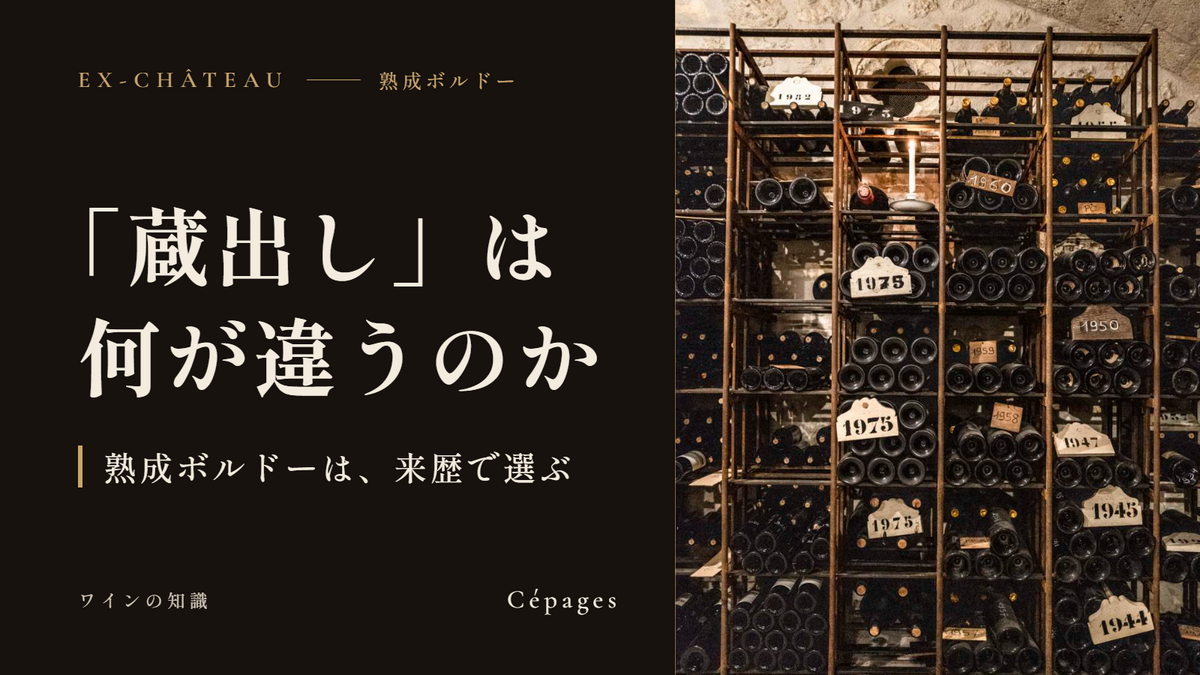
What Makes "Ex-Château" Different? Choosing Mature Bordeaux by Provenance
Once a wine is past thirty years old, the difference between bottles becomes greater than the difference between vintages (see the previous article).
Where does that difference come from? The answer lies in where and how the wine has spent its time, from the day it was bottled to the day it is poured. In a word, its provenance.
When choosing a mature Bordeaux, it is important to check where the bottle has come from before asking what year it is. This article explains why, and what the term "ex-château" really means.
Same vintage, same label, but not the same wine
After bottling, a Bordeaux Grand Cru sets out on a long journey: négociants, importers, retailers, private cellars, and then auctions and the secondary market. Over twenty or thirty years, it is not unusual for a bottle to change hands many times.
Each change of ownership means transport and a new place of storage. The problem is that almost none of this is recorded. Did the bottle spend a summer in a warehouse without air conditioning, or has it always been in an underground cellar? The label will not tell you.
Heat does more than dull a wine's flavour. The liquid expands, pushes up the cork and causes seepage. The course of the wine's ageing itself is thrown off. Once that has happened, no amount of careful storage afterwards will undo it.
Fill level, the state of the cork and marks on the capsule all offer clues. Even so, there is a limit to what can be seen from the outside. That is why, with mature wine, the route a bottle has travelled matters as much as the year on its label.
What "ex-château" means
An ex-château bottle is one that has aged in the château's own cellar and is taken directly from the château. From bottling to the day it is shipped, it has never left the place where it was made.
Ex-château provenance guarantees two things:
- Storage conditions: the wine has aged undisturbed in the château's cellar, at stable temperature and humidity
- Provenance: it has passed through no one else's hands, and there are no gaps in its history
That does not mean an ex-château bottle will always suit your taste. Where in a wine's drinking window you like to be is personal, and with any old wine, bottle variation never disappears entirely. What ex-château sourcing removes is the biggest uncertainty of all: how has this bottle been treated?
One more point, about appearance. Bottles that have spent a long time in a cellar sometimes have stained labels. This is a sign that they have been kept in a humid environment, and it has nothing to do with the quality of the wine inside. In some cases, it is more reassuring than a label that looks too clean.
After the château: how the wine travels
Even an ex-château bottle is worth little if it is badly handled after it leaves the château. Provenance does not end at the château gate. It continues until the bottle reaches you.
Cépages is part of the Elan Group, headquartered in Bordeaux. Sourcing and international transport are managed together within the group, and our mature Bordeaux reaches Japan by the following route:
- Taken directly from the château's cellar
- Consolidated at a bonded warehouse in Europe, where it waits for shipment under temperature control
- Shipped by sea in a reefer (temperature-controlled) container, held at a constant temperature for the roughly one-month voyage across the equator
- Stored in a temperature-controlled warehouse in Japan (Suzuyo's Oi Logistics Center, kept at 14°C), with temperature and humidity monitored around the clock and loading done without exposure to outside air
- Delivered to you: by refrigerated delivery for every order from June to September, and on request in other seasons
The third step matters most. Inside an ordinary dry container in direct sunlight, temperatures above 50°C are not uncommon. So that a wine which has aged quietly for thirty years is not ruined in its final month, Cépages ships every wine in reefer containers.
The full route is set out on our page "How we ship and store our wines".
When choosing a mature ex-château Bordeaux
To finish, two things to keep in mind when choosing an ex-château Bordeaux.
When it arrives, let it rest first. However carefully a wine is transported, it is unsettled after a journey. A mature wine with sediment returns to its true form if it is stood upright for several days to a week or more before opening. This is covered in detail in the previous article.
It is fine to ask about provenance. When you buy a mature wine, there is nothing rude about asking, "Where has this bottle come from?" Buy from a seller who can answer. That is the most reliable way to choose mature wine. At Cépages, we are happy to answer questions about how individual wines were sourced.
Provenance before vintage
The value of a mature wine is decided by the quality of the time it has spent. Even a great vintage becomes a different wine if it fails to get through a single summer somewhere along the way.
Check the provenance before you look at the year. That alone should spare you many disappointments in choosing mature Bordeaux.
At Cépages, we offer Bordeaux Grands Crus at their drinking window, delivered directly from the châteaux' cellars.
▶ See our ex-château Bordeaux Grands Crus
If you are looking for a wine from a particular year, or would like to know which vintages are drinking well now, feel free to ask us on LINE.
*We do not sell alcohol to anyone under the age of 20.
Written by 秋元賢介
Private Sales Manager at Cépages and a JSA-certified sommelier, with more than 20 years in the trade, largely at major and independent wine retailers. Writes with the aim of bridging passionate producers and drinkers in Japan, carrying that enthusiasm through to the page.

Leave a comment
This site is protected by hCaptcha and the hCaptcha Privacy Policy and Terms of Service apply.