
The Evolution of Natural Winemaking — Sancerre Today, Through the Philosophy of Domaine Denizot
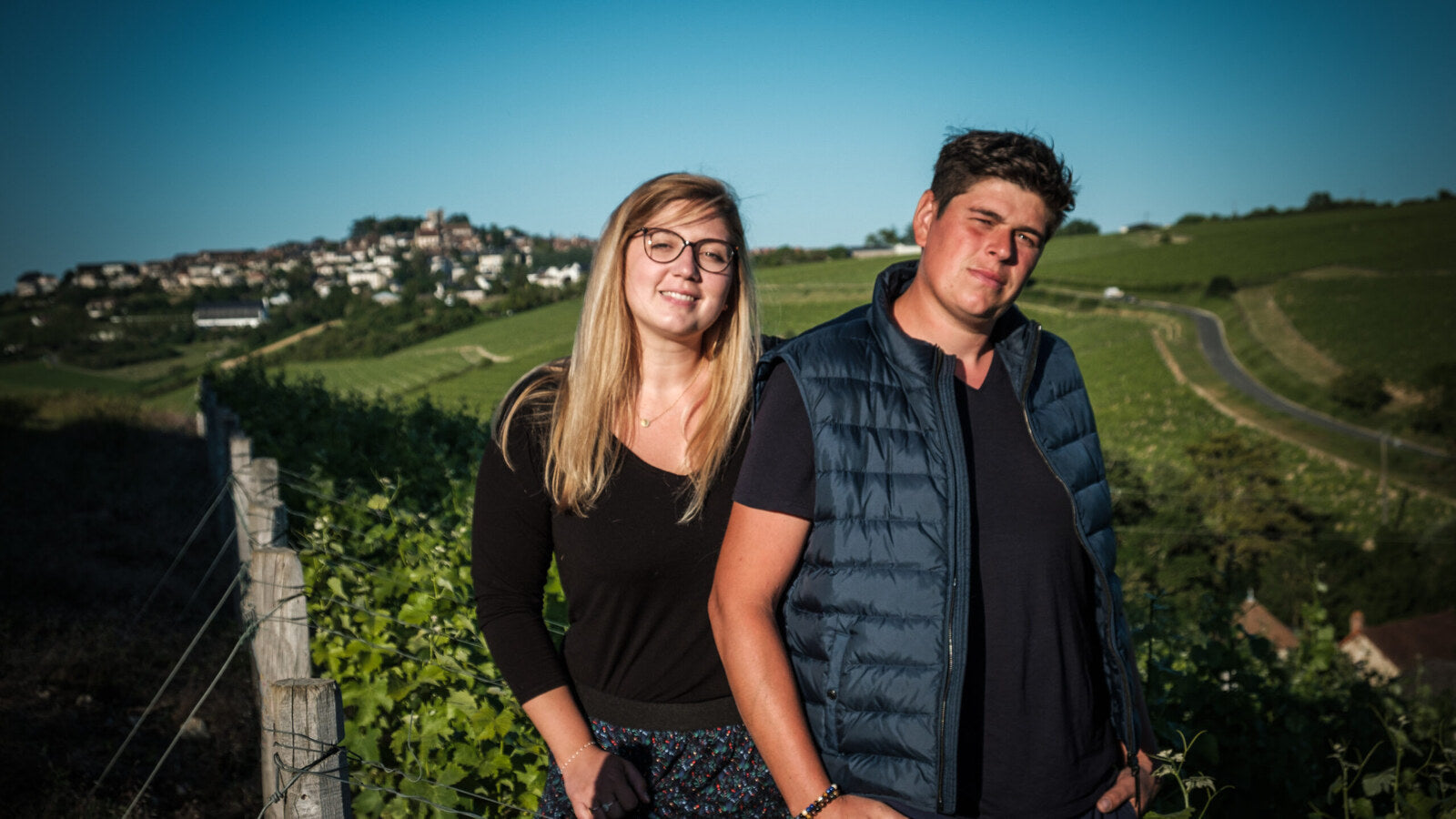
Domaine Denizot is based in Verdigny, one of Sancerre's finest villages. When Jennifer Denizot — proprietor and winemaker — visited Japan recently, we were fortunate enough to sit down with her. What emerged were two technical decisions that underpin the sheer purity of the Denizot wines, and that appear on neither the website nor the technical sheets. We set them out here for the trade in particular.
First, the groundwork — the Denizot philosophy of minimal intervention
The Denizot family have grown vines in Sancerre for six generations — eight, if you count their history working the land. Today Thibault and Jennifer run more than 20 hectares between them, producing wines under two appellations, Sancerre and Pouilly-Fumé. Their vineyards, dominated by caillottes (Portlandian limestone), yield a Sauvignon Blanc of sharp minerality and taut, driving acidity.
Their approach in the cellar has never wavered: the quality of a wine is decided in the vineyard, and the work in the cellar is to preserve the fruit's natural expression without diminishing it. Hand harvesting, gravity flow, fermentation with indigenous yeasts — intervention is kept to an absolute minimum throughout.
The two choices Jennifer described to us show that this philosophy is no mere slogan: it runs all the way down into the finest technical judgements.
1. Sulphur dioxide of volcanic origin
For their SO₂, Denizot use sulphur dioxide of volcanic origin — a form far closer to the natural state.
Plenty of growers push SO₂ levels down as far as they possibly can. What makes the Denizot approach interesting is that it is not only about reducing the quantity, but about choosing the source. According to Jennifer, using volcanic SO₂ gets the wine closer still to a genuinely additive-free state than a minuscule dose of the conventional, industrially produced antioxidant would — while keeping quality reliably stable.
The risks that come with zero-sulphur (sans soufre) wines — bottle variation caused by shipping and storage conditions, mousiness, volatile acidity — are facts of life that those of us in importing and retail cannot afford to ignore. The Denizot solution is one answer to two demands that so often pull against each other: a commitment to natural winemaking, and a quality that holds firm all the way to Japan.
2. Barrels sealed with steam rather than fire
The second innovation concerns the barrels used for fermentation and ageing.
Conventional cooperage puts the inside of the barrel to the flame — the toasting stage. The degree of toast lends the wine nuances of vanilla, spice and roasted aromas, and is in itself a significant tool of stylistic design. But for a terroir such as Sancerre, whose whole identity rests on delicate minerality and freshness, toast is a double-edged sword.
The barrels Denizot use have had their grain sealed with steam instead. Because the wood is never charred, no toast-derived character settles over the wine, and the fine minerality and freshness that come from the terroir survive intact. More importantly — and here we borrow Jennifer's own words — this is not simply a matter of subtraction. A barrel whose grain has been properly sealed by steam delivers oxygen transfer that is neither excessive nor insufficient, and that, she says, actively amplifies the expression of terroir.
A gentle, gradual supply of oxygen of a kind the reductive environment of a stainless steel tank can never provide — obtained without paying for it in oak aromatics. Here lies the secret of the Denizot texture: barrels used, yet never tasted.
What it means that Sancerre has no classification — and the opportunity that creates
The other striking thread in our conversation with Jennifer was her candour about a structural problem facing the appellation itself.
One of the great reasons Sancerre remains hard to read is that it has no concept of Premier Cru or Grand Cru as Chablis does. There are parcels — Les Bouffants, Côte de l'Épée, Les Monts Damnés — that growers themselves regard as being in a class apart, and yet no official hierarchy places them at the summit on the label. For the buyer, Sancerre simply offers no equivalent to the plain signal of value that separates village Chablis from a Grand Cru.
Jennifer also serves as an ambassador for AOC Sancerre, and establishing such a classification is precisely the sort of work one hopes she will drive forward. The subject is indeed under discussion, she told us — though the feeling on the ground is that it will be some time yet before anything is settled.
Now let us turn that around. The very opacity of an unclassified region is, from another angle, an opportunity for those who know what they are looking at. Understand what the terroir of a given single-vineyard Sancerre actually is — the soil, the gradient, the aspect, and why growers hold that particular parcel in such regard — and you can secure genuinely fine wine at a fair price now, before a First or Grand Cru classification drives it upward.
Consider what has happened in Burgundy. Classification and reputation have pulled prices along with them, and there is no shortage of names now trading well above what the quality alone would justify. Sancerre's great single vineyards, meanwhile, are still sold under the plain village-level banner of "Sancerre". If a classification does arrive one day, the wines from the parcels that would stand at its summit are not currently pricing in that standing at all. For any buyer able to read terroir, that is an exceptionally favourable position from which to make a decision.
What to look for at the tasting bench
How do these two technical choices show themselves in the glass? We would encourage you to examine the Denizot wines on the following points.
First, purity of aroma — how directly the gunflint minerality and the citrus and white-fruit notes rise, with no blanket of toast over them. Next, texture on the palate — the roundness and depth that barrel ageing brings, with the outline of the fresh acidity never once blurred. And finally, stability of condition: how the wine holds after opening, and how little it varies from bottle to bottle. That last point should prove genuinely valuable when it comes to serving them.
Natural and dependable, both at once. The Denizot answer is not declaimed loudly; it lives in the details — the origin of the SO₂, the making of the barrel. What Jennifer's visit revealed was an exceptionally modern and intelligent piece of winemaking design, coming from a family domaine of long tradition.
The wines of Domaine Denizot can be found here
https://cepages-wines.com/collections/domaine-denizot
Written by 秋元賢介
Private Sales Manager at Cépages and a JSA-certified sommelier, with more than 20 years in the trade, largely at major and independent wine retailers. Writes with the aim of bridging passionate producers and drinkers in Japan, carrying that enthusiasm through to the page.

Leave a comment
This site is protected by hCaptcha and the hCaptcha Privacy Policy and Terms of Service apply.